

Minority Card Registration
The Punjab Government has launched an important welfare program for minority families across the province and registration is officially open right now.
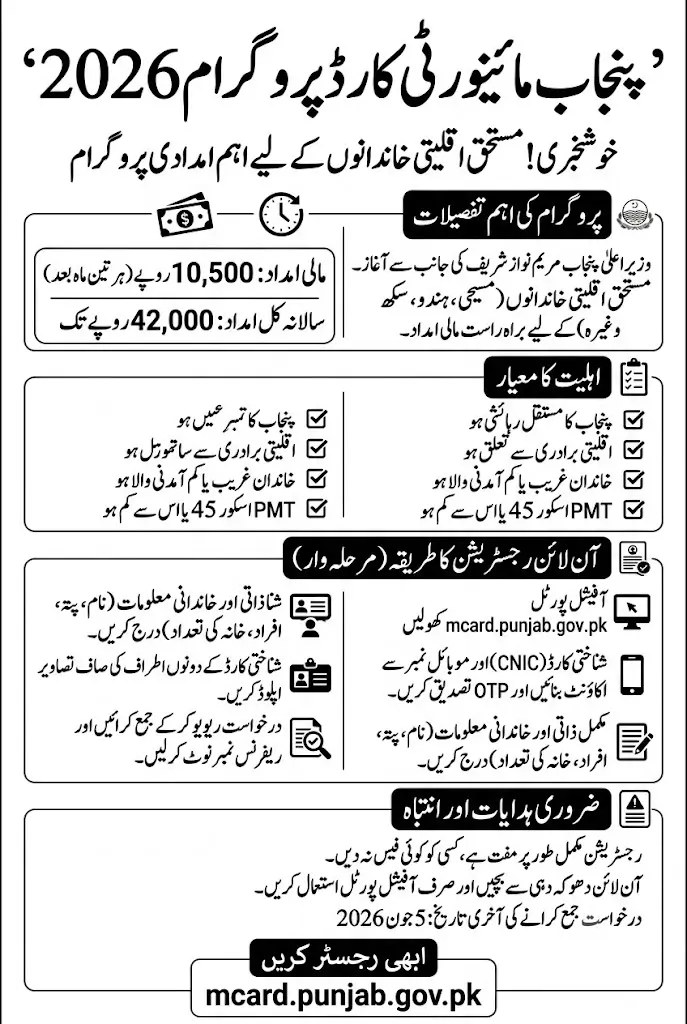
Chief Minister Punjab Maryam Nawaz has announced the Punjab Minority Card Program 2026. Under this program, deserving minority families will receive Rs.10,500 every three months as direct financial support. The entire registration process is online through the official portal mcard.punjab.gov.pk.
If you belong to a minority community in Punjab and your family qualifies, this guide covers everything you need to know from eligibility to the exact steps to apply.
Quick Answer
The Punjab Minority Card Program 2026 provides Rs.10,500 quarterly financial assistance to deserving minority families in Punjab. Registration is open online at mcard.punjab.gov.pk. Applicants must be Punjab residents from a minority community with a PMT score of 45 or below and low household income. Registration is completely free.
Also Read: Apna Khet Apna Rozgar Scheme Online Apply
Key Details
| Detail | Information |
|---|---|
| Program Name | Punjab Minority Card Program 2026 |
| Launched By | CM Punjab Maryam Nawaz Sharif |
| Financial Aid | Rs.10,500 per quarter |
| Annual Total | Up to Rs.42,000 per year |
| Official Portal | mcard.punjab.gov.pk |
| PMT Score Required | 45 or below |
| Who Can Apply | Minority community residents of Punjab |
| Registration Fee | Completely free |
| Coverage | All districts of Punjab |
What Is the Punjab Minority Card Program
The Punjab Minority Card is a direct financial support initiative launched by Chief Minister Maryam Nawaz specifically for low income minority families living across Punjab. The program targets families from minority communities including Christians, Hindus, Sikhs, and other recognized minorities in Pakistan who are financially vulnerable and cannot easily meet their basic household needs.
The idea behind the program is simple. Minority families in Pakistan often face additional economic challenges alongside general poverty. This card gives them a direct quarterly payment that helps cover food, medicine, children’s education, and other essential expenses without any conditions or complicated requirements.
Each eligible family receives Rs.10,500 every three months. Over a full year that adds up to Rs.42,000 in total support. The payment is made directly to the registered applicant and the entire process from registration to payment is handled through official government channels.
How to Register Online at mcard.punjab.gov.pk — Step by Step Method
The registration process is fully online and has been designed to be simple even for people who are not very familiar with technology. Follow these steps carefully.
Step 1: Open the Official Portal Open your mobile browser or computer browser and go to mcard.punjab.gov.pk. Always confirm you are on the correct address with the .gov.pk domain. Do not use any other website claiming to offer Minority Card registration. Only the official government portal is authorized.
Step 2: Create Your Account On the portal homepage you will see an option to register or create a new account. Click on it. Enter your CNIC number and your registered mobile phone number. An OTP will be sent to your mobile number within seconds. Enter the OTP to verify your identity and your account will be created immediately.
Step 3: Fill in Personal Details After logging in, fill in your complete personal information. This includes your full name as it appears on your CNIC, your father’s name, date of birth, home address, and district. Enter every detail carefully and make sure it matches exactly what is written on your CNIC. Any mismatch between your form details and CNIC information can cause your application to be delayed or rejected.
Step 4: Add Family Information The form will ask about your household. Enter the number of family members, their ages, and their relationship to you. This information is used to assess your household’s financial situation and determine your eligibility level.
Step 5: Enter Minority Community Details Select your minority community from the list provided. This is where you confirm your religious or community background that makes you eligible for this specific program.
Step 6: Upload Required Documents Upload clear photos of your CNIC front and back. Upload any supporting documents related to your minority status if required by the portal. Make sure all uploaded images are clear and all text is fully readable. Blurry or incomplete uploads will cause your application to be flagged for review.
Step 7: Submit Your Application Review all the information you have entered before submitting. Check your name, CNIC number, address, family details, and uploaded documents one more time. Once everything looks correct, click the submit button.
Step 8: Save Your Reference Number After submission the portal will show a reference number or application ID. Screenshot this immediately or write it down in a safe place. You will need this number to track your application status later.
Also Read: How to Get Benazir Taleemi Wazaif Rs. 5000 In 2026
Who Is Eligible to Apply
Before opening the portal, check whether your family meets all of the following conditions set by the Punjab Government.
You must be a permanent resident of Punjab. Any district qualifies whether you live in Lahore, Faisalabad, Multan, Gujranwala, Rawalpindi, Bahawalpur, Sialkot, or a smaller town anywhere in the province.
You must belong to a minority community. This includes Christians, Hindus, Sikhs, and other officially recognized minority groups in Pakistan. The program is specifically designed for non-Muslim minority families.
Your family must be low income or financially deserving. The program targets households that genuinely struggle to cover basic monthly expenses.
Your PMT score must be 45 or below. PMT stands for Proxy Means Test. It is a government scoring system that measures household poverty based on income, assets, family size, housing conditions, and other factors. A score of 45 or below means your household falls in the deserving category under government criteria.
If you meet all four conditions, you are likely eligible and should apply before the June 5 deadline.
What Is a PMT Score and How to Check It
Many applicants are confused about the PMT score requirement. Here is a simple explanation.
The Proxy Means Test is a system used by the Government of Pakistan to assess how financially vulnerable a household is. It takes into account factors like your monthly income, the type of house you live in, your assets, number of family members, education level, and employment status. Based on all these factors the system assigns a score to your household.
A score of 45 or below means your household is considered financially deserving under the current government criteria. The lower your score the higher your level of financial need according to the system.
If you have previously registered with BISP, Ehsaas, or any other government welfare program, your PMT score is likely already recorded in the national database. When you apply on mcard.punjab.gov.pk, the system may check your score automatically using your CNIC.
If your score is not on record or you have never applied for any welfare program before, visit your nearest BISP Tehsil office to request a household assessment. The assessment is free and takes your current household situation into account.
Also Read: How to Apply for Wazir-e-Azam Apna Ghar Program 2026
A Personal Experience How this Works
Let me share something here because it puts the real value of this program in perspective.
My colleague Daniel works as a school peon in Lahore. He is a Christian and has lived in the same rented room in a working class neighborhood for over twelve years. His salary barely covers rent and groceries. He has three children in school and the fees alone are a constant source of stress for his family.
When the Punjab Minority Card program was announced, a relative helped Daniel check his eligibility and register on mcard.punjab.gov.pk. The process took about twenty minutes on a mobile phone. He submitted his CNIC details, filled in his family information, and uploaded his documents. Three weeks after submission he received a confirmation message that his application had been approved.
The first quarterly payment of Rs.10,500 went directly toward his children’s school fees and a month’s supply of groceries. His wife told him it was the first time in years that they did not have to borrow money from a neighbor to manage the month.
That is exactly the kind of family this program was built for.
Documents You Need Before Applying
Keep these ready before you start the registration process to avoid stopping halfway through.
- You need your original CNIC that is valid and not expired.
- You need your registered mobile phone number that is linked to your CNIC.
- You need clear photos of both sides of your CNIC for uploading.
- You need basic household information including number of family members and their ages.
- If you have a PMT score confirmation document from a previous welfare program registration, keep that handy as well.
What Happens After You Submit Your Application
After submission the Punjab Government reviews your application. The system checks your CNIC details against NADRA records and verifies your PMT score against the national poverty database.
If your application is approved you will receive an official SMS notification on your registered mobile number. You will then be informed about how and when your first quarterly payment of Rs.10,500 will be made.
If your application requires additional verification or if there is any issue with your submitted information, you may be contacted by the relevant office for clarification. Respond promptly to any such contact to avoid delays in your approval.
Most applications submitted with complete and accurate information are processed within a few weeks. Applications submitted close to the June 5 deadline may take slightly longer due to the higher volume of submissions near the cutoff date.
Also Read: How to Check Aghosh Program Payment Online Without Visiting Any Office Full Guide 2026
Why You Should Apply Before June 5 and Not Wait
The deadline of 5 June 2026 is firm. No extensions have been announced. Applications submitted after this date will not be considered for the current program cycle.
There is another reason not to wait. Online portals typically experience high traffic in the final days before a deadline. Slow loading times, system delays, and connectivity issues near the cutoff date can make the process frustrating. Applying today or in the next few days means you complete the process smoothly without any last minute technical problems.
Applying early also gives you time to fix any issues. If your application is flagged for missing information or document problems, you have time to correct and resubmit before the deadline passes.
Important Safety Warning
The Punjab Government has issued a clear warning to all applicants about online fraud.
Only use the official website mcard.punjab.gov.pk. Any other website with a similar name or design is fake and unauthorized. Never share your OTP with anyone. No government official or BISP representative will ever ask for your OTP over the phone or through a message.
Never pay anyone to register you for the Punjab Minority Card. The registration is completely free at every step. If any person, agent, or website asks for money to complete your registration, refuse and report them immediately.
Be careful about fake social media pages and WhatsApp groups claiming to offer fast registration or guaranteed approval for a fee. All of these are fraudulent. The only legitimate registration is through mcard.punjab.gov.pk directly.
Also Read: Ehsaas Program Registration 8171 NADRA 2026
FAQs
What is the Punjab Minority Card Program 2026?
The Punjab Minority Card is a welfare initiative launched by Chief Minister Maryam Nawaz to provide Rs.10,500 quarterly financial support to deserving minority families across Punjab. Eligible families from minority communities with a PMT score of 45 or below can apply online at mcard.punjab.gov.pk before June 5, 2026.
Who can apply for the Punjab Minority Card?
Permanent residents of Punjab who belong to a recognized minority community, have a low household income, and have a PMT score of 45 or below are eligible to apply. This includes Christian, Hindu, Sikh, and other officially recognized minority families in Punjab.
How much financial assistance does the Punjab Minority Card provide?
Each eligible family receives Rs.10,500 every quarter which is every three months. Over a full year this amounts to Rs.42,000 in total direct financial support paid to the registered applicant.
Is there any registration fee for the Punjab Minority Card?
No. Registration at mcard.punjab.gov.pk is completely free. There are no charges at any step of the process. Anyone asking for payment to register you or guarantee your approval is committing fraud.
What is a PMT score and how do I check mine?
PMT stands for Proxy Means Test. It is a government poverty scoring system based on your household income, assets, and living conditions. A score of 45 or below qualifies you as financially deserving. If you are registered with BISP or Ehsaas, your score may already be on record. Visit your nearest BISP Tehsil office for a free household assessment if your score is not yet recorded.
What if I face problems during online registration?
Check that you are using the correct website mcard.punjab.gov.pk and that your CNIC and mobile number details are accurate. If technical issues persist, contact the Punjab Government helpline or visit your nearest district social welfare office for assistance.
Final Words
The Punjab Minority Card Program 2026 is a real and meaningful opportunity for minority families across Punjab who have been managing financial difficulty quietly for years. The registration is online, the process is simple, and the deadline is June 5.
If you qualify or know someone who does, act today. Open mcard.punjab.gov.pk, follow the steps, and submit before the deadline. Sharing this information within your church, temple, or community could help a family that genuinely needs this support find it in time.