

Rs 23 Billion Development Package for Kacha Area
Punjab Chief Minister Maryam Nawaz has announced a comprehensive development package worth Rs 23 billion for the Kacha area, one of the most historically underserved regions in Pakistan. This landmark initiative covers a wide range of sectors including education, health, infrastructure, security, agriculture, and skills development, making it the most ambitious government intervention the Kacha area has seen in recent memory. The announcement marks a clear shift in policy attention toward communities that have long existed on the margins of mainstream development planning.
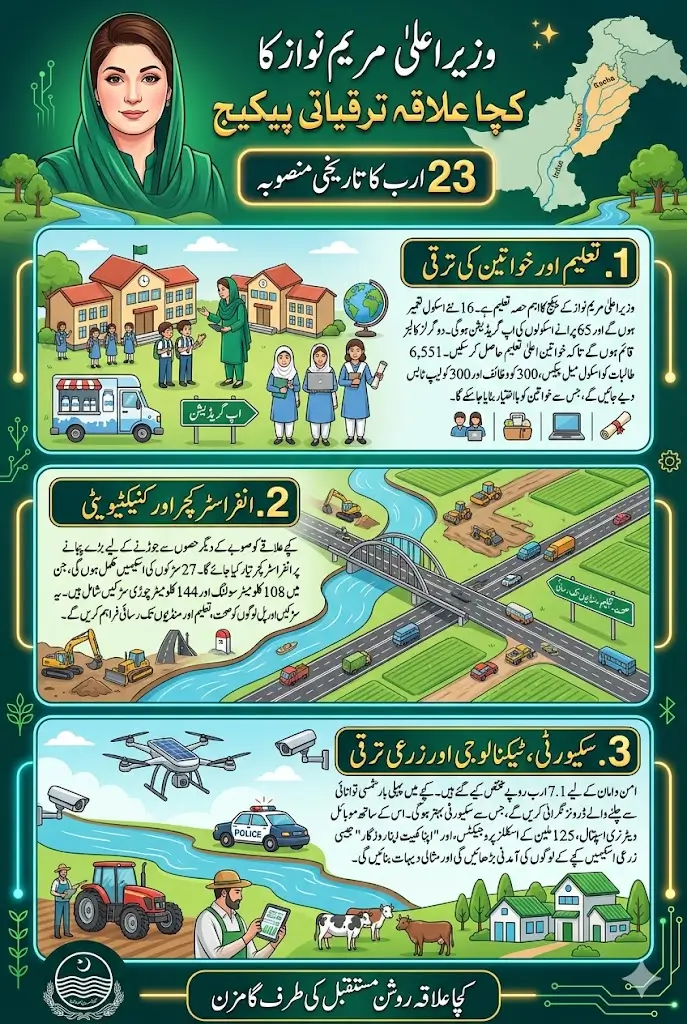
The package is not limited to construction and bricks but extends into social welfare, digital surveillance, scholarship programs, and rural empowerment initiatives. From new schools and girls colleges to mobile veterinary hospitals and solar-powered drone surveillance, the scope of this development plan reflects a serious commitment to transforming the quality of life for residents of the Kacha area across multiple dimensions simultaneously.
You Can Also Read: Punjab Launches Mobile Pest Surveillance Squads to Protect Crops
What Is the Kacha Area and Why This Package Matters?
The Kacha area refers to the riverine belt along the Indus River in southern Punjab, a region that has historically struggled with poor infrastructure, limited access to education and healthcare, law and order challenges, and economic isolation. Despite its large population and agricultural potential, development investment in this belt has been minimal compared to urban and peri-urban areas of the province.
The announcement of a Rs 23 billion package by Chief Minister Maryam Nawaz is therefore not just a financial commitment but a political and administrative acknowledgment that the Kacha area deserves priority attention. Bringing schools, hospitals, roads, bridges, and digital tools to this region will help close the development gap that has widened over decades of neglect and inconsistent governance.
Education Initiatives at the Heart of the Development Plan
Education has been given substantial weight in this development package, with multiple interventions planned that address different aspects of the learning crisis in the Kacha area. The announcements cover school construction, upgradation, student support, and infrastructure for girls specifically, which is a particularly critical need in rural and riverine communities where female enrolment has traditionally been very low.
A total of 65 existing schools will undergo construction, rehabilitation, and upgradation work, while 16 brand new schools will also be built from scratch. Two girls colleges will be established in the area, which will significantly expand post-school education access for young women. Beyond buildings, the initiative includes direct student support through meal programs and scholarships.
The education-related announcements from this package are wide-ranging and cover multiple needs at once. Here is what has been officially confirmed:
- 16 new schools will be constructed in the Kacha area to expand access to basic education
- 65 existing schools will be rehabilitated, upgraded, and improved under the development programme
- 2 girls colleges will be established, opening higher education pathways for female students
- 6,551 female students will receive School Meal Milk Packs to support nutrition and attendance
- 300 students will be awarded Honhaar scholarships to support academic achievement and retention
- 300 students will also receive laptops to bridge the digital divide in this underserved region
These combined education interventions represent one of the most layered and inclusive education investments the Kacha area has ever received in a single government announcement.
You Can Also Read: Balochistan Launches Green Line Bus Service in Quetta
Infrastructure Development Including Roads and Bridges
Connectivity has always been one of the most serious barriers to development in the Kacha area. Without proper roads and bridges, communities remain cut off from markets, hospitals, schools, and government services. The new package directly addresses this by committing to a substantial road and infrastructure development programme across the region.
A total of 27 road schemes will be completed as part of this initiative, covering 108 kilometres of soling roads and 144 kilometres of wider road networks. This scale of road development will dramatically improve movement within and across the Kacha belt, making it easier for residents to access services, transport agricultural produce, and connect with surrounding areas on a daily basis.
Budget Allocation Across Key Sectors
To understand how the Rs 23 billion package is being distributed, here is a clear breakdown of the spending priorities across the three main categories:
| Sector | Allocated Budget | Key Focus Areas |
|---|---|---|
| Law and Order | Rs 7.1 billion | Security infrastructure and peace restoration |
| Social Infrastructure | Rs 13.9 billion | Schools, hospitals, roads, bridges, and welfare |
| Other Development | Rs 1.7 billion | Skills, agriculture, rural development projects |
| Total Package | Rs 23 billion | Comprehensive area development programme |
Social infrastructure receives the largest share at Rs 13.9 billion, reflecting the government’s recognition that long-term stability in the Kacha area depends on building functional institutions and public services rather than relying solely on security measures.
Health, Agriculture, and Skills Development Announcements
Beyond education and roads, the development package extends into health services, agriculture support, and vocational training. The government has directed that mobile veterinary hospitals and labs be made available in the Kacha area, which is significant given that livestock is a primary source of income for many families in the region. Keeping animals healthy directly protects the livelihoods of rural households.
A skills development project worth Rs 125 million will also be launched in the area, aimed at creating practical employment opportunities for local youth. Alongside this, the Apna Khet Apna Rozgar programme will be introduced in the Kacha area for the first time, giving smallholder farmers access to support that helps them cultivate their land more productively and generate income. An Ideal Village Project has also been approved to develop model communities within the region.
You Can Also Read: CM Punjab Rahmat Card Online Registration Started at rahmatcard.punjab.gov.pk
Security and Technology Upgrades for the Kacha Area
Law and order has been a persistent challenge in the Kacha area, and the government has allocated Rs 7.1 billion specifically toward improving the security situation. This investment will go into security infrastructure and related initiatives aimed at restoring lasting peace to a region where criminal activity has previously disrupted daily life and scared away investment.
On the technology front, the Kacha area will for the first time benefit from modern solar-powered drone surveillance. This is a significant step for a region that has rarely been at the forefront of technological deployment by government agencies. Solar-powered drones will allow authorities to monitor the area remotely, respond to threats more efficiently, and reduce the manpower burden on ground security forces while improving overall situational awareness.
Here is a consolidated view of the additional initiatives confirmed under this package:
- Mobile veterinary hospitals and labs will be provided to support livestock health in the area
- A skills project worth Rs 125 million will be launched to create employment for local youth
- Apna Khet Apna Rozgar programme will be introduced in Kacha for the first time
- Ideal Village Project has received approval to create model rural communities in the region
- Solar-powered drone surveillance will be deployed in the Kacha area for the first time ever
- Rs 7.1 billion allocated for law and order improvements to restore peace and stability
Each of these commitments targets a specific vulnerability in the Kacha area’s development profile and together they create a framework for genuine and lasting change.
Final Thoughts
The Rs 23 billion development package announced by Chief Minister Maryam Nawaz for the Kacha area is one of the most comprehensive government interventions this region has ever witnessed. With investments spanning education, health, roads, security, agriculture, skills, and technology, the package addresses the full spectrum of challenges that have held the Kacha area back for generations. If implemented with accountability and transparency, this initiative has the potential to transform the living standards of one of Punjab’s most neglected communities.
What matters now is execution. Announcements of this scale have been made in the past for various underserved areas across Pakistan, and the results have often fallen short of the ambition. The residents of the Kacha area deserve to see these commitments translated into real schools, functional hospitals, completed roads, and working services within a reasonable and transparent timeframe.
You Can Also Read: Kisan Card Phase III Loan Payers Winners List Has been Released
FAQs
Q1: What is the total value of the development package announced for the Kacha area?
Chief Minister Maryam Nawaz has announced a development package worth Rs 23 billion for the Kacha area, covering education, health, roads, security, agriculture, and skills development.
Q2: How many schools will be built or improved under this development plan?
A total of 16 new schools will be constructed and 65 existing schools will be rehabilitated and upgraded, along with 2 new girls colleges to be established in the Kacha area.
Q3: What financial support will students in the Kacha area receive under this package?
300 students will receive Honhaar scholarships, 300 will be given laptops, and 6,551 female students will receive School Meal Milk Packs under the education component of the package.
Q4: How much has been allocated for law and order in the Kacha area development plan?
Rs 7.1 billion has been specifically allocated for law and order improvements, while Rs 13.9 billion goes toward social infrastructure and Rs 1.7 billion covers other development activities.
Q5: What new technology is being introduced in the Kacha area for the first time?
Solar-powered drone surveillance is being deployed in the Kacha area for the very first time, enabling remote monitoring and improving security response capabilities across the region.