HEC Degree Attestation System 2026
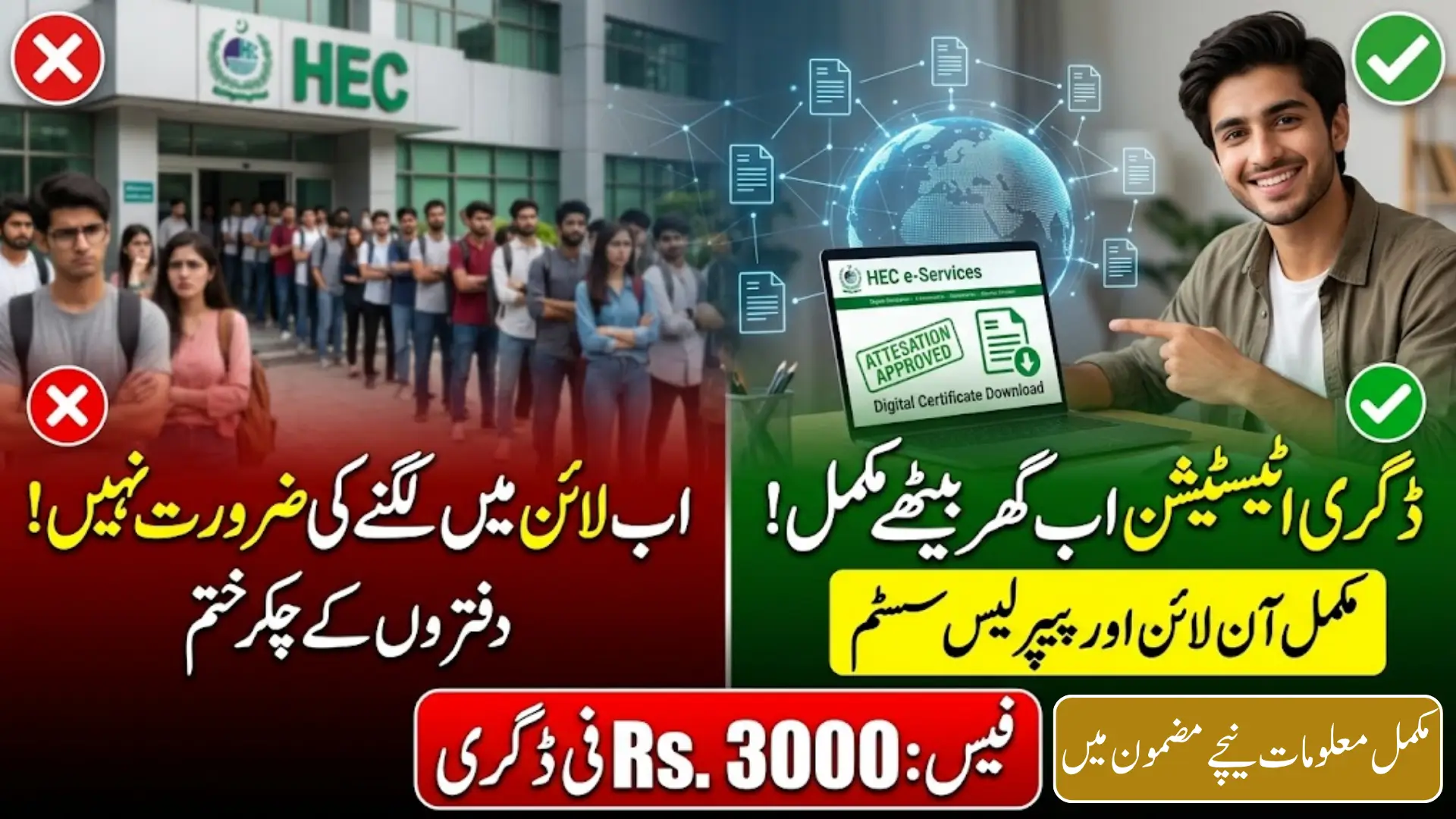
A big shift has quietly taken place in Pakistan’s higher education system. Students and graduates no longer need to stand in long queues or visit offices for degree attestation.
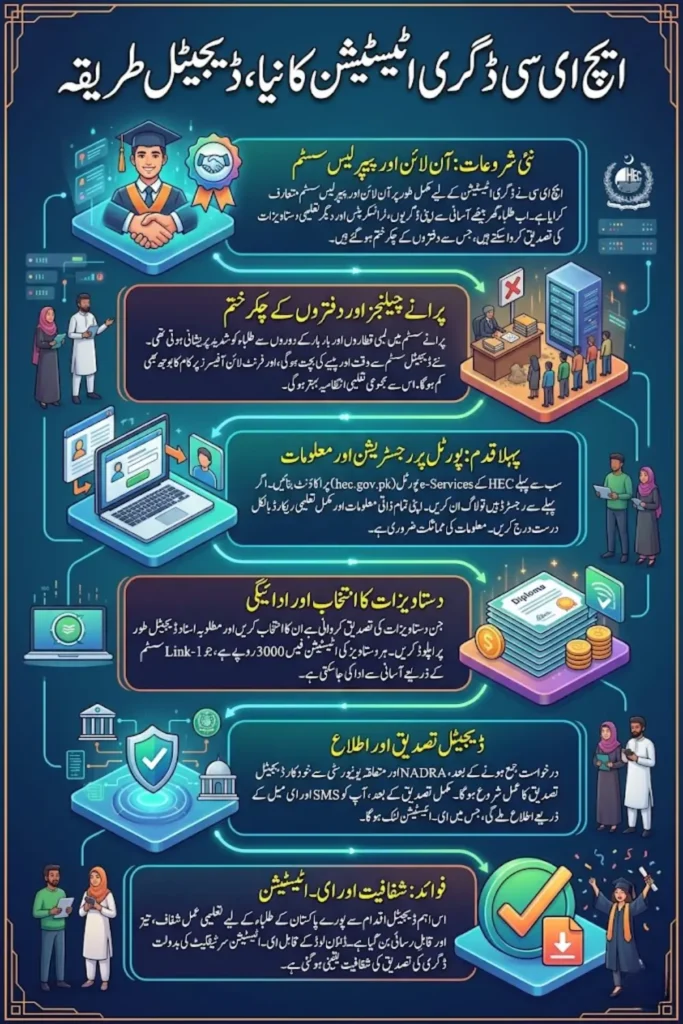
The Higher Education Commission has officially introduced a fully online and paperless HEC degree attestation system, allowing applicants to complete the entire process from home.
Here’s the surprising part. No physical submission. No repeated office visits. Just a digital process through the official portal. But how does it actually work, and what has changed for students across Pakistan?
Quick Answer
The HEC degree attestation system is now fully online, allowing students in Pakistan to apply for degree, transcript, provisional certificate, and equivalence letter attestation through the HEC e-Services Portal. The fee is Rs. 3000 per document, and verification is completed digitally without physical visits.
You Can Also Read: Imam Masjid Wazifa Check Online Status 25,000 Step By Step Method
Quick Info Table
| Detail | Information |
|---|---|
| System Name | HEC Degree Attestation System (DAS) |
| Launch Type | Fully Online & Paperless |
| Fee per Document | Rs. 3,000 |
| Portal | HEC e-Services Portal |
| Documents Covered | Degree, Transcript, Certificate, Equivalence Letter |
| Payment Method | 1-Link / 1-Bill System |
| Verification Bodies | NADRA + Universities |
What is the HEC Degree Attestation System?
The new system introduced by the Higher Education Commission Higher Education Commission Pakistan is designed to remove manual paperwork completely.
Now applicants can:
- Apply online anytime
- Upload academic documents digitally
- Pay fee through 1-Link system
- Track application status online
Honestly speaking, this is one of the biggest digital upgrades in Pakistan’s education administration system in recent years.
You Can Also Read: Parwaaz Card Apply Online 2026 – Eligibility Requirements and Application Process
Why This Change Matters for Students?
Earlier, degree attestation was a time-consuming process. Students had to:
- Visit HEC offices physically
- Wait in long queues
- Submit original documents multiple times
Now things are different. The new system removes all physical visits. That alone saves days, sometimes weeks.
Here’s the interesting part. The system is also designed to reduce fraud and fake degrees through digital verification.
How to Apply Online Step-by-Step Method
The process is now fully structured inside the portal.
Step 1: Create Account
- Go to the portal hec.gov.pk
- Register on the HEC e-Services Portal
- Existing users can log in directly
Step 2: Enter Personal Details
You must enter:
- Full name
- Father’s name
- Date of birth
- CNIC details
- Address
Make sure details match your documents exactly. Even a small mismatch can delay approval.
Step 3: Add Academic Records
You need to enter full education history:
- Matric / SSC
- Intermediate / HSSC
- Bachelor’s degree
- Master’s or higher education
Step 4: Select Documents
You can choose:
- Degree
- Transcript
- Provisional certificate
- Equivalence letter
System automatically calculates fee.
Step 5: Upload Documents
Required uploads include:
- CNIC front and back
- Academic certificates
- Transcripts
Step 6: Payment
Fee is generated and paid via:
- 1-Link / 1-Bill system
You Can Also Read: Apna Khet Apna Rozgar Scheme Online Apply and Get Agricultural land
What Happens After Submission?
Once submitted, the system starts verification:
- Data check through NADRA
- University verification
- Final HEC review
After approval, users receive:
- SMS confirmation
- Email notification
- Downloadable e-attestation certificate
No physical pickup required.
Fee Structure Explained
The fee is simple and fixed:
- Rs. 3000 per document
This includes:
- Degree attestation
- Transcript verification
- Provisional certificate
- Equivalence letter
For many students, this brings transparency in cost structure, which was missing earlier.
HEC Chairman’s Statement
According to HEC Chairman Niaz Ahmed Akhtar, the system removes the need for physical visits and original document submission.
The goal is to make the process:
- Faster
- Easier
- Fully accessible across Pakistan
This also aligns with broader digital governance efforts in the education sector.
You Can Also Read: CM Punjab Bike Scheme 2026 Online Registration
What This Means for Students in Pakistan?
For students in cities like Karachi, Lahore, Islamabad, and even remote areas, this is a major relief.
Possible impacts:
- Less travel cost
- Faster document processing
- Reduced workload for HEC offices
- Better transparency in verification
But one question still remains. Will server load and verification delays affect processing time during peak months?
That is something students will be watching closely.
FAQs
1. What is HEC degree attestation system?
It is a fully online system that allows students in Pakistan to get their degrees and documents attested without visiting HEC offices.
2. What is the fee for attestation?
The fee is Rs. 3000 per document including degrees, transcripts, and certificates.
3. How can I apply for HEC attestation?
You need to register on the HEC e-Services Portal, fill details, upload documents, and submit payment online.
4. Is physical visit required anymore?
No, the entire process is now digital and paperless.
5. How long does verification take?
Time may vary depending on university and NADRA verification process.
6. Which documents are required?
CNIC, academic certificates, transcripts, and related documents must be uploaded.
7. How will I receive my certificate?
You will get SMS/email notification and can download it directly from your HEC account.
You Can Also Read: 8171 CNIC Check Online 13500 May Payment Eligible Or Not And Payment Released Or Not
Conclusion
The HEC degree attestation system marks a clear shift toward digital education services in Pakistan. It reduces paperwork, cuts waiting time, and brings the entire process online for students.
Now the real test will be execution speed and system stability, especially when application numbers increase. If managed well, this could become one of the most useful digital reforms in Pakistan’s education sector.