

Benazir Income Support Programme Quarterly Payment Raised
This is the news that millions of registered BISP women across Pakistan have been waiting for.
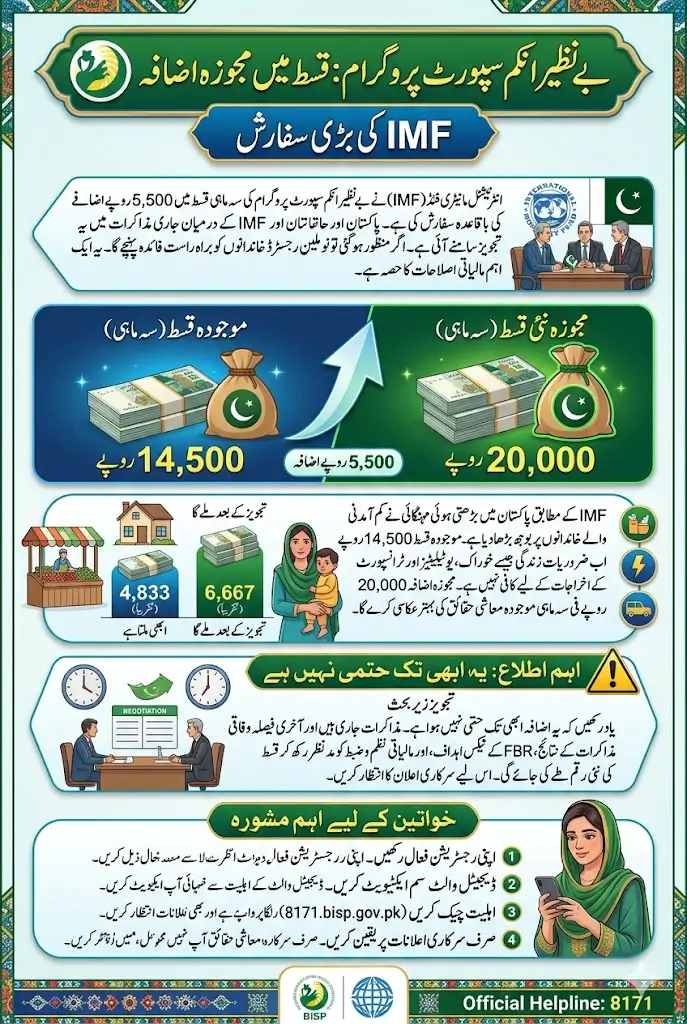
The International Monetary Fund has formally recommended that the Benazir Income Support Programme quarterly payment be raised from Rs.14,500 to Rs.20,000. That is an increase of Rs.5,500 per quarter. And it is coming directly from the IMF itself, not a rumor, not social media speculation, but an official recommendation made during ongoing negotiations between IMF representatives and Pakistani government authorities.
But wait. Before celebrations begin, there are some important details every BISP beneficiary needs to understand. This is still a proposal. Talks are ongoing. And the final decision has not been announced yet. Here is everything you need to know right now.
Quick Answer
The IMF has recommended increasing the Benazir Income Support Programme Kafalat quarterly payment from Rs.14,500 to Rs.20,000, an increase of Rs.5,500. This recommendation came during active negotiations between the IMF mission and Pakistani authorities. The proposal is currently under discussion and has not been officially approved yet. A final decision is expected as part of the broader IMF program review framework.
Also Read: BISP Payment Stopped? Here Is Exactly Why and How to Fix It in 2026
Key Information
| Detail | Information |
|---|---|
| Program | Benazir Income Support Programme |
| Current Quarterly Payment | Rs. 14,500 |
| Proposed New Payment | Rs. 20,000 |
| Increase Amount | Rs. 5,500 per quarter |
| Recommended By | International Monetary Fund (IMF) |
| Status | Under Discussion, Not Yet Confirmed |
| Negotiations Involving | BISP Officials, IMF Mission, FBR |
| Effective From | Next Financial Year (Proposed) |
| Meetings Scheduled | 4 total, 1 with BISP, 3 with FBR |
What Exactly Did the IMF Recommend?
Let us be very clear about what happened so there is no confusion. An IMF mission is currently in Pakistan conducting an official program assessment. As part of these ongoing discussions, IMF representatives met with BISP officials and reviewed the entire social protection system from top to bottom.
During these meetings, BISP officials gave the IMF mission a full briefing. The registered data under the BISP programme was presented. Family registration numbers were shared. The current quarterly payment structure was explained. And the financial requirements for the next fiscal year were also laid out in detail. After reviewing all of this information, the IMF formally recommended that the quarterly BISP payment be raised from Rs.14,500 to Rs.20,000.
The reason behind this recommendation is straightforward. Inflation has risen sharply in Pakistan over the past two years. The cost of basic necessities like food, utilities, and transport has increased significantly for low income families. The current Rs.14,500 quarterly payment is no longer sufficient to meaningfully support those families against these rising costs. The IMF believes Rs.20,000 per quarter better reflects current economic realities for the families BISP is designed to support.
Why Is the IMF Involved in BISP Payment Decisions?
This is a question many people are asking. Why is an international organization recommending changes to a Pakistani welfare program?
Here is the thing. Pakistan is currently operating under an active IMF program. As part of this program, the IMF regularly reviews Pakistan’s economic policies including fiscal spending, tax collection, and social protection programs.
BISP falls directly under social protection spending. The IMF monitors whether Pakistan is adequately protecting its most vulnerable citizens, especially during periods of economic adjustment when inflation rises and purchasing power falls.
When the IMF recommends increasing BISP payments, it is not interference. It is actually a positive push. The IMF is telling Pakistan that its current welfare spending is not enough to adequately protect low income families and that the Kafalat amount needs to increase to reflect real world costs. Actually, this recommendation actually works in favor of registered beneficiaries.
How Much Difference Will Rs.20,000 Make for Registered Families?
Currently, registered BISP women receive Rs.14,500 every three months. That works out to roughly Rs.4,833 per month. With the proposed increase to Rs.20,000 per quarter, the monthly equivalent becomes approximately Rs.6,667 per month.
That is an additional Rs.1,833 per month in real terms. For a low income family in cities like Lahore, Karachi, Multan, Quetta, or Peshawar, that difference genuinely matters. It covers additional food expenses. It helps with utility bills. It reduces the financial pressure that millions of Pakistani families face every single month. Now here is the important question. Is this confirmed?
Also Read: 8171 Check May 14500 Online Complete Step by Step Method For Unpaid Beneficiaries 2026
Is the Rs.20,000 Payment Confirmed? The Honest Answer
No. Not yet. This needs to be said clearly so no one is misled. The IMF recommendation is real and it is being taken seriously in ongoing negotiations. But the final decision has not been made yet.
According to sources familiar with the discussions, the proposed increase will most likely take effect in the next financial year if approved. Government officials and IMF representatives are still working through the details as part of the broader program framework.
Three possible outcomes remain on the table right now.
- Outcome One: The full Rs.20,000 quarterly payment is approved as recommended by the IMF.
- Outcome Two: A partial increase is agreed upon, somewhere between Rs.14,500 and Rs.20,000, as a compromise during negotiations.
- Outcome Three: The increase is approved but implementation is delayed to a later quarter of the next financial year.
Which outcome happens depends on the final results of these negotiations. Four meetings were scheduled for today alone. One with BISP officials and three separate meetings with FBR representatives covering tax policy and fiscal reform discussions.
What Else Is the IMF Pushing For Alongside This Recommendation?
The IMF is not only recommending an increase in BISP payments. At the same time, the IMF has also pushed Pakistan to end all sales tax exemptions. This means certain goods and services that were previously exempt from sales tax may become taxable.
For ordinary Pakistani families, this creates a mixed picture. On one hand, BISP payments may increase by Rs.5,500 per quarter. On the other hand, removing sales tax exemptions could increase the cost of some everyday items.
This is exactly why these negotiations are complex and why a final announcement has not been made yet. The government needs to balance increased social protection spending with broader fiscal adjustments being demanded by the IMF simultaneously.
Also Read: Latest Update! BISP Survey Suspended Until June 15, 2026 Due to Benazir Mobile SIM Distribution
What Should BISP Registered Women Do Right Now?
Honestly speaking, the answer right now is simple. Wait for the official announcement.
Do not make any financial plans based on the Rs.20,000 figure until it is officially confirmed by BISP or the government. Proposals can change during negotiations. The final amount could be different from what is currently being discussed. Here is what every registered beneficiary should do in the meantime:
- Make sure your BISP registration is active and updated
- Ensure your Digital Wallet SIM is activated so you receive payments instantly when they are released
- Check your eligibility status at 8171.bisp.gov.pk if you have any doubts
- Call 8171 if you have any questions about your account or registration status
- Follow only official BISP announcements for confirmed payment information
Do not trust unofficial sources, WhatsApp forwards, or social media posts claiming the increase has already been approved. Wait for the official word.
Background: How Has the BISP Kafalat Payment Changed Over Time?
For context, the Kafalat quarterly payment has been increased several times over the years as inflation and economic conditions have changed in Pakistan.
The program was originally designed to provide a basic quarterly stipend to the most vulnerable families. Over time, as living costs have risen, the payment amount has been revised upward through a combination of government decisions and international program requirements.
The current Rs.14,500 quarterly amount was set during a previous round of adjustments. The proposed increase to Rs.20,000 would represent the largest single jump in the payment amount and would reflect the significant inflation Pakistan has experienced over the past two years. If approved, this would benefit an estimated nine million registered families currently enrolled in the Benazir Income Support Programme across Pakistan.
Also Read: BISP 8171 Online Registration Process Explained
Final Thought
The IMF recommendation to raise the Benazir Income Support Programme quarterly payment to Rs.20,000 is genuinely significant news for millions of low income families across Pakistan. It reflects a recognition that current support levels are not keeping pace with rising costs and that registered beneficiaries deserve more meaningful financial assistance.
But the key word right now is proposed. Negotiations are ongoing. The final number could change. Keep your wallet activated, your registration updated, and your eyes on official BISP announcements. When the decision is finalized, registered women will be the first to know through their 8171 payment alerts.
Also Read: BISP 8171 May 2026 Stipend Schedule Announced
FAQs
Has the Benazir Income Support Programme quarterly payment officially been raised to Rs.20,000?
Not yet. The IMF has formally recommended increasing the quarterly Kafalat payment from Rs.14,500 to Rs.20,000 during ongoing negotiations with Pakistani authorities. This remains a proposal under active discussion and has not been officially confirmed or approved by the government as of now.
Why did the IMF recommend increasing the BISP Kafalat payment?
The IMF recommended the increase because inflation in Pakistan has significantly raised the cost of basic necessities for low income families. The current Rs.14,500 quarterly payment no longer adequately covers essential expenses and the IMF believes Rs.20,000 better reflects current economic conditions for vulnerable households.
When will the increased BISP payment take effect if approved?
According to sources close to the negotiations, the proposed increase is being considered for the next financial year. However, the exact timing depends on the outcome of ongoing IMF program review discussions and no official date has been confirmed yet.
How much will each registered BISP woman receive per month if the increase is approved?
If the quarterly payment is raised to Rs.20,000, each registered beneficiary will effectively receive approximately Rs.6,667 per month. This compares to the current monthly equivalent of roughly Rs.4,833 based on the existing Rs.14,500 quarterly payment.
How many families will benefit if the Rs.20,000 quarterly payment is approved?
Approximately nine million registered families currently enrolled in the Benazir Income Support Programme across Pakistan would benefit from the proposed payment increase if it is officially approved and implemented.
What should I do to make sure I receive the increased payment when it is announced?
Make sure your BISP registration is active and updated. Activate your Digital Wallet SIM if you have not already done so. Check your eligibility status at 8171.bisp.gov.pk and call 8171 if you have any questions. Only follow official BISP announcements for confirmed payment information.
Is the IMF also demanding other changes to Pakistan’s economy alongside the BISP increase?
Yes. Alongside recommending the BISP payment increase, the IMF has also pushed Pakistan to end all sales tax exemptions as part of broader fiscal reforms. These parallel demands are part of the same ongoing program review negotiations and are being discussed simultaneously with the BISP payment proposal.